
HEGEL H150 > The Amplifier That Lives Up to Its Nickname - Reviews: H-Fi+, Revista On Off, Hi-Files & Hi-Fi News
In the world of high-fidelity audio, hyperbole is cheap. Superlatives get worn smooth by overuse, and bold product nicknames are often little more than marketing bravado dressed up as confidence. So when Hegel Music Systems internally referred to their new H150 as "The Prodigy" during development, it would have been reasonable to raise an eyebrow.
Reasonable – but, as it turns out, mistaken.
The Hegel H150 is the Norwegian manufacturer's entry point into their current integrated amplifier range. At first glance, that positioning might suggest a product of modest ambition. In practice, spending any time with the H150 quickly dismantles that assumption. This is a machine built with the same engineering philosophy that drives Hegel's flagship products, compacted into a form factor that fits almost any listening room and priced at a level that makes genuine high-end performance accessible to a much wider audience.
At INTEK Hi-Fi, we tested the H150 across a range of loudspeakers, sources – both analogue and digital – and streaming services. The conclusion arrived quickly and never wavered: this amplifier is something special.
---
Design and Build: Understated on the Outside, Sophisticated Within
Hegel has long held to a clear design philosophy: keep the user interface simple, hide the complexity inside. The H150 is perhaps the clearest expression of that principle yet.
The chassis is full-width at 43 cm, which positions it as a standard hi-fi component that integrates easily into any existing rack or shelf system. Its depth of just 35 cm is genuinely compact for an amplifier of this capability, making it far easier to accommodate than many rivals. It is available in both black and white – the black carrying a subtly warm dark-grey tone that looks refined under most lighting, and the white offering a clean, contemporary aesthetic that suits modern interiors beautifully.
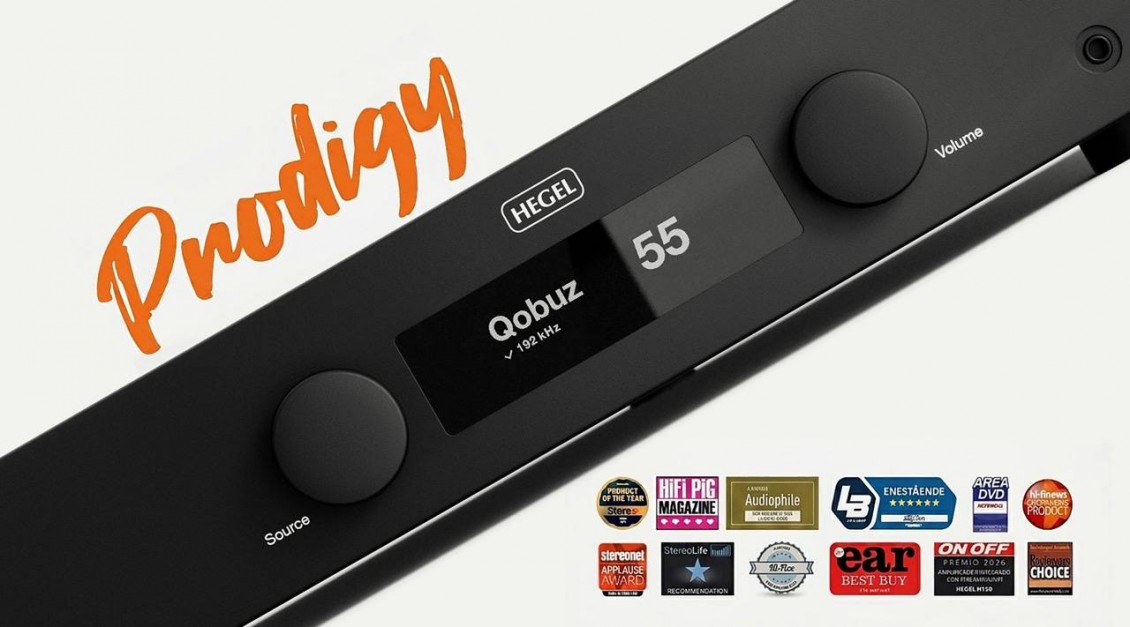
The front panel is milled from solid aluminium and features just two control dials – one for input selection, one for volume – flanking a central OLED display. The display is clear and legible from across a room, and can be dimmed or switched off entirely to suit the listening environment. Power is handled by a recessed button on the underside of the unit; an unconventional choice that preserves the cleanness of the front panel. The top cover is steel, perforated with heat vents.
At 9.7 kg, the H150 has a reassuring solidity. Every surface and control communicates quality without ostentation – which is precisely the Scandinavian way.
---
Technology: The Thinking Behind the Sound
To understand why the H150 sounds the way it does, it helps to understand where Hegel came from. The company's founding philosophy emerged from a 1988 thesis written by Bent Holter at the Norwegian University of Science and Technology in Trondheim. Holter's central insight was that the methods conventionally used to reduce distortion in transistor amplifiers often introduced new problems – degrading the damping factor, for instance, or sacrificing dynamics in the process of cleaning up the signal.
His answer was to take a different path entirely. Rather than relying on negative feedback – which catches and corrects errors after they occur – Holter developed a local, adaptive feedforward system that anticipates and prevents distortion before it can enter the signal path. The result eliminates crossover distortion, which is the particular form of interference inherent to all Class AB amplifiers and one to which human hearing is acutely sensitive.
That technology became SoundEngine. The version implemented in the H150 is SoundEngine 2 – a refined, patented evolution of the original – and it is one of the primary reasons this amplifier sounds as clean, composed and dynamically expressive as it does.
The practical outcome of SoundEngine 2 includes a damping factor of more than 2,000 – an extraordinary figure at this price level, and one that has profound implications for bass control and loudspeaker authority. The higher the damping factor, the more precisely the amplifier can govern the movement of a loudspeaker driver. In listening terms, that translates directly into tighter, more articulate bass and a more stable, coherent stereo image.
The power supply is built around a large, ultra-low-noise toroidal transformer and high-speed capacitors that provide instantaneous current delivery. The rated output of 2 × 75 W into 8 ohms is modest on paper, but the combination of high damping factor and a stable power supply means the H150 can drive demanding loudspeakers – including loads as low as 2 ohms – with a grip and authority that many higher-rated amplifiers cannot match.
The built-in digital-to-analogue converter uses a four-layer design informed by Hegel's well-regarded Viking CD player. It supports PCM up to 24-bit/192 kHz on coaxial and USB connections, and up to 24-bit/96 kHz on the optical inputs. There is no 32-bit processing, no DSD, no MQA. Hegel makes no apologies for these omissions: these are formats that occupy the enthusiast press but rarely the listening rooms of actual music lovers. The DAC is built to handle the formats people genuinely use, and to handle them exceptionally well.
---
Connectivity: Everything Needed, Nothing Superfluous
The H150's input and output configuration reflects a clear-eyed assessment of what a modern all-in-one amplifier actually needs to do.
On the analogue side, there is a balanced XLR input and an unbalanced RCA line input. The more notable provision, however, is a high-quality Moving Magnet phono stage – a fully realised turntable input that most amplifiers at this level simply do not include. For owners of MM-based turntables, the H150 removes the need for a separate phono preamplifier entirely.
The digital input array includes:
- Two optical S/PDIF inputs (24-bit/96 kHz) – one optimised for TV connections
- One coaxial S/PDIF input (24-bit/192 kHz)
- One USB-B input (24-bit/192 kHz) for direct computer connection
- One USB-A input for flash drives or powered hard disks, with library browsing supported via the Hegel Control app
- One RJ45 network input
A coaxial digital output enables what Hegel calls DAC Loop mode: signals from the digital inputs can be passed through to active speakers, a secondary system, or an external DAC, without losing any of the H150's own functionality. This level of flexibility is unusual in an amplifier at this price point and adds meaningfully to the unit's long-term versatility.
On the output side, a variable unbalanced RCA output accommodates subwoofers or external power amplifiers, and a headphone output serves private listening. Any input can be fixed at a high output level, allowing volume control to be handled by a connected home cinema receiver or multiroom streamer.
The only genuinely notable omissions are Bluetooth and HDMI ARC or eARC. For a streaming amplifier of this nature, neither is a dealbreaker – but they are worth acknowledging for those who might need them.
---
Streaming: A Complete Ecosystem in One Box
The H150's streaming credentials are comprehensive. Built-in support covers Spotify Connect (including lossless-tier streaming), Tidal Connect, Qobuz Connect, Apple AirPlay, Google Cast, UPnP, and Roon Ready certification – all accessed via a single network connection.
Over-the-air firmware updates ensure the platform evolves alongside the streaming landscape. New services and functionality are added automatically, without any user intervention required.
Control is available through several means: a supplied aluminium remote handset, the free Hegel Control application for iOS and Android, and voice commands via Google Home or Apple Home. The Hegel Control app provides full input and volume management, plus access to built-in internet radio and podcast functionality powered by the airable platform. The amplifier also arrives pre-loaded with popular TV remote codes, allowing immediate control via an existing handset.
Input-sensing on digital connections means the H150 will automatically wake from standby and switch to the active source. Adjustable auto-standby conserves energy during periods of inactivity. These features collectively make the H150 genuinely effortless to live with day-to-day – a virtue that becomes more apparent the longer you own it.
---
Sound Quality: Where It All Comes Together
For all that can be said about specifications, streaming protocols, and amplifier topology, the question that ultimately matters is the simplest one: how does the Hegel H150 sound?
The short answer is: with considerable authority, precision, and musical engagement.
The bass is the first thing that announces itself, and it does so with authority. It is not a soft or generous bass – it is controlled, defined, and deeply informative. The distinction between tight, articulate bass and the bloated, over-exuberant low end found in less well-damped designs is immediately audible. With the H150, bass lines have shape, texture and purpose. This is bass that carries musical information rather than simply asserting mass.
This characteristic makes the amplifier particularly compelling with genres where rhythmic precision and low-frequency structure are central to the experience – electronic music, jazz, reggae, orchestral works with substantial double-bass presence. The H150 handles all of them with the same assured grip.
Moving into the midrange, the character remains open, articulate and transparent. Detail is rendered without artifice: the amplifier is not in the business of flattering recordings or imposing a particular tonal character. What was captured in the recording room is what you hear in your listening room. This kind of accuracy, far from being clinical, tends to produce a more emotionally engaging listening experience – because the music is presented honestly, with all its intended expressiveness intact.
The treble is balanced with care. It is present enough to convey air, sparkle and fine detail, yet never tips into brightness or hardness. Extended listening sessions – the true test of any high-frequency presentation – remain entirely comfortable.
The stereo image is well proportioned, with genuine width and convincing depth. Instruments and voices occupy distinct spaces within the soundfield, and those spaces have a natural solidity that contributes to the sense of a three-dimensional performance.
Perhaps most notably, the H150 demonstrates a rhythmic expressiveness and temporal coherence that marks a clear step forward from earlier models in the Hegel range. It responds to the beat of music with a directness and energy that makes listening an active, engaged experience rather than a passive one.
---
How It Compares: Context and Competition
The H150 replaces the H120, which was itself a well-regarded amplifier in the Hegel line. The step forward is substantial: the H150 introduces the MM phono stage the H120 lacked, the DAC Loop output, Qobuz Connect, and the evolved SoundEngine 2 circuitry.
In the broader market, the H150's competition includes amplifiers from Naim, Cambridge Audio, Rotel, and Rega at comparable price points. What distinguishes the H150 is the combination of streaming comprehensiveness, analogue flexibility (particularly the phono stage), and a sound quality that, in our experience, consistently exceeds what its price would lead you to expect.
For a listener building a system from scratch, the arithmetic is compelling. The H150 replaces a separate streaming player, a phono preamplifier, a standalone DAC, and an integrated amplifier – all while delivering a level of performance across those functions that dedicated separates at this price rarely match individually.
---
Technical Specifications
| Parameter | Value |
|---|---|
| Power Output | 2 × 75 W (8 Ω, 1 kHz, 1% THD) |
| Minimum Load | 2 Ω |
| Analogue Inputs | 1× XLR Balanced, 1× RCA Unbalanced |
| Phono Input | 1× RCA (Moving Magnet) |
| Digital Inputs | 2× Optical S/PDIF (24/96), 1× Coaxial S/PDIF (24/192), 1× USB-B (24/192), 1× USB-A, 1× Network (24/192) |
| Digital Output | 1× Coaxial S/PDIF (24/192) |
| Line Output | 1× Variable RCA |
| Streaming | Spotify Connect, Tidal Connect, Qobuz Connect, Apple AirPlay, Google Cast, UPnP, Roon Ready |
| Streaming Formats | MP3, WAV, FLAC, ALAC, AIFF, AAC, PCM, Ogg |
| Frequency Response | 5 Hz – 100 kHz |
| Signal-to-Noise Ratio | > 100 dB |
| Crosstalk | < −100 dB |
| THD | < 0.01% @ 50 W, 8 Ω, 1 kHz |
| Damping Factor | > 2,000 |
| Dimensions (W × D × H) | 43 × 35 × 10 cm |
| Weight | 9.7 kg |
| Finish Options | Black, White |
---
Conclusion: Exceptional, Not Simply Good-for-the-Money
The Hegel H150 is not merely "impressive at its price." It is simply impressive – full stop. The qualification has become unnecessary.
Every aspect of the design reflects a clear intention: to make no unnecessary compromises, to solve real problems with real engineering, and to deliver a listening experience that serves the music rather than the specification sheet. The SoundEngine 2 technology provides a sonic foundation that produces audible results; the streaming platform is genuinely complete and future-proofed; the analogue provisions are more extensive than most rivals offer; and the physical design communicates quality without extravagance.
The H150 earns its nickname. Prodigies, by definition, demonstrate abilities that exceed what is expected of them given their circumstances. The Hegel H150 does exactly that – and in doing so, sets a standard that the competition at this level will find extremely difficult to match.
At INTEK Hi-Fi, the Hegel H150 is one of our most enthusiastic recommendations of the year. We invite you to come and hear it for yourself.
*Contact INTEK Hi-Fi for a listening demonstration, further information, or to purchase the Hegel H150.*