
0 Comment(s)
274 View(s)
09 Jun 2026
LOWERING THE NOISE FLOOR: The One Thing That Separates a Good Hi-Fi System from an Extraordinary One
The Silence Between the Notes
Ask any seasoned listener what separates a truly extraordinary audio system from one that is merely good, and you'll often hear the same answer: it's not louder, not brighter, not more detailed in the obvious sense. It simply sounds more real.That quality — the sense that musicians are present in the room, that notes have weight and air around them, that the space between sounds has texture — is almost always the result of one thing: a well-managed noise floor.
And yet it remains the most consistently overlooked aspect of hi-fi system building.
What Is the Noise Floor, and Why Does It Matter?
Every audio system produces a baseline level of unwanted noise and interference before it plays a single note. This is the noise floor — and it acts as a veil between you and the music.The higher the noise floor, the more of the music is obscured. Fine harmonic detail, the natural decay of instruments in a space, the breath before a sung phrase, the texture of a bowed string — these are not lost dramatically. They dissolve quietly, gradually, in a way that is easy to miss until they are restored.
Over the past decade, some of the most significant advances in high-end audio have come not from adding more power or more resolution, but from reducing what should not be there in the first place. Manufacturers working in this space have consistently found that lowering the intrinsic noise floor of a component — and of a system as a whole — produces gains in musical communication that far exceed what higher specifications alone can achieve.
At INTEK Hi-Fi, we regard noise floor management as one of the most important and rewarding areas of audio optimisation, whether you are building a new system or refining an existing one.
Three Pillars of Noise Floor Reduction
There are three distinct areas where the noise floor of an audio system can be actively lowered. Each addresses a different source of unwanted interference, and each delivers its own character of improvement. Together, they can transform how a system performs.1. Acoustic Noise Floor Reduction
The room is the first and most important component in your system.No piece of equipment — regardless of price or pedigree — will perform as intended in an acoustically untreated space. Early reflections, standing waves and modal resonances all add their own layer of colouration and confusion to what you hear. These cannot be solved by changing your amplifier. They are a property of the room itself.
Acoustic treatment addresses this through the strategic placement of absorption and diffusion panels, alongside careful attention to speaker positioning and listening position. The result is a listening environment where the system can actually be heard — clearly, accurately and without the acoustic signature of the room competing with the recording.
Crucially, effective acoustic treatment does not mean transforming a living room into a recording studio. Contemporary solutions are designed to work within domestic spaces, and in many cases enhance both the sonic and visual character of a room.
2. Mechanical Noise Floor Reduction
Vibration is the silent saboteur of hi-fi performance.Every component in your system is sensitive to mechanical vibration — from the turntable and its cartridge, to the DAC, preamplifier and power amplifier. Vibration enters a system from multiple sources: structure-borne energy from traffic, footfall and HVAC systems; airborne energy from the loudspeakers themselves; and internally-generated energy from transformers, fans and resonant chassis panels.
Mechanical noise floor reduction addresses this through:
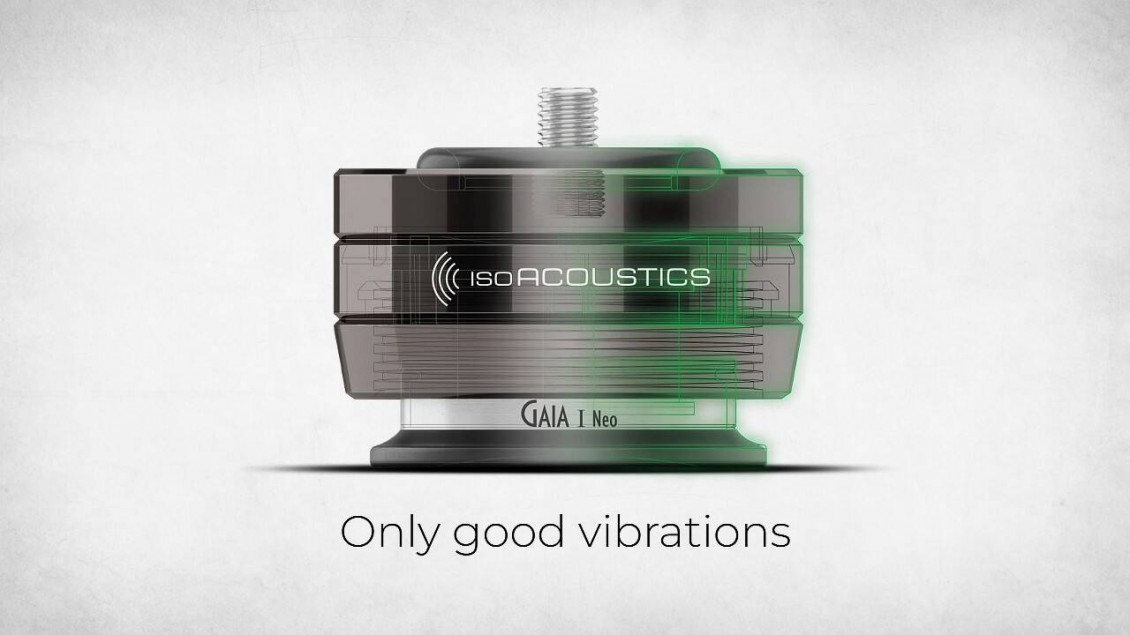
• Isolation platforms and equipment feet — cones, decoupling pods and constrained-layer platforms that absorb and dissipate vibrational energy
• Purpose-designed equipment racks with inherent resonance control
• Turntable-specific solutions including antivibration platforms and subchassis upgrades
When mechanical noise is properly managed, the improvement is often described in terms of focus and timing. Notes start and stop cleanly. The stereo image tightens and deepens. There is less of a sense of the music being smeared across time.
3. Electrical Noise Floor Reduction
The mains supply in any modern home is a significant source of audio interference.Switch-mode power supplies, LED lighting, network routers, smart home devices, phone chargers — each of these introduces electromagnetic interference into the electrical supply. An audio system draws its power from the same network, and unless steps are taken to address this, that interference becomes part of the signal chain.
Electrical noise floor reduction encompasses:
• Grounding boxes and cables — dedicated solutions that provide a controlled path for the drainage of unwanted electrical energy, often with a dramatic effect on clarity and naturalness
• Mains conditioning and power filtration — devices that clean the incoming supply before it reaches sensitive audio components
• Specialist audio fuses — an often-overlooked point of improvement that can yield surprising results
• High-quality power cables — which play a greater role than many assume in protecting components from mains-borne interference
The improvements from effective electrical noise management tend to manifest as greater clarity, more natural tonal balance, improved low-level detail resolution and a more convincing sense of space and depth in the recording.
Where Do You Begin?
Acoustics first — always.Without a well-managed acoustic environment, gains made in the mechanical and electrical domains will be partial at best. The room must be addressed before the system can be properly heard, and therefore before its other weaknesses can be properly diagnosed.
Beyond acoustics, the relative priority of mechanical and electrical treatment will vary depending on the specific system, its components and its environment. This is where experience matters: knowing where a particular system has the most room for improvement requires familiarity with the equipment, the room and the cumulative effect of different approaches in combination.
The Results Are Not Subtle
The improvements that come from working systematically through these three areas are consistently described by those who experience them as transformative rather than incremental. Not a small step forward. A different listening experience.Systems that previously seemed competent but somehow uninvolving come to life. Music that felt presented at arm's length begins to communicate directly. The experience of listening — genuinely listening — becomes more natural, more absorbing and, ultimately, more enjoyable.
INTEK Hi-Fi: Expert Guidance for the Discerning Listener
At INTEK Hi-Fi, we have spent years working with audiophiles and music lovers across Slovenia to help them get the best possible performance from their systems. We understand that every room, every system and every listener is different — and that the path to exceptional sound is rarely the same twice.Whether you are starting from scratch or looking to take an existing system to the next level, we offer expert advice on acoustic treatment, mechanical isolation and electrical preparation tailored to your specific situation.
We would be delighted to hear about your system and help you find the most effective path forward.
INTEK Hi-Fi | Ljubljana | Slovenia
High-End Audio, Consultation and Distribution