
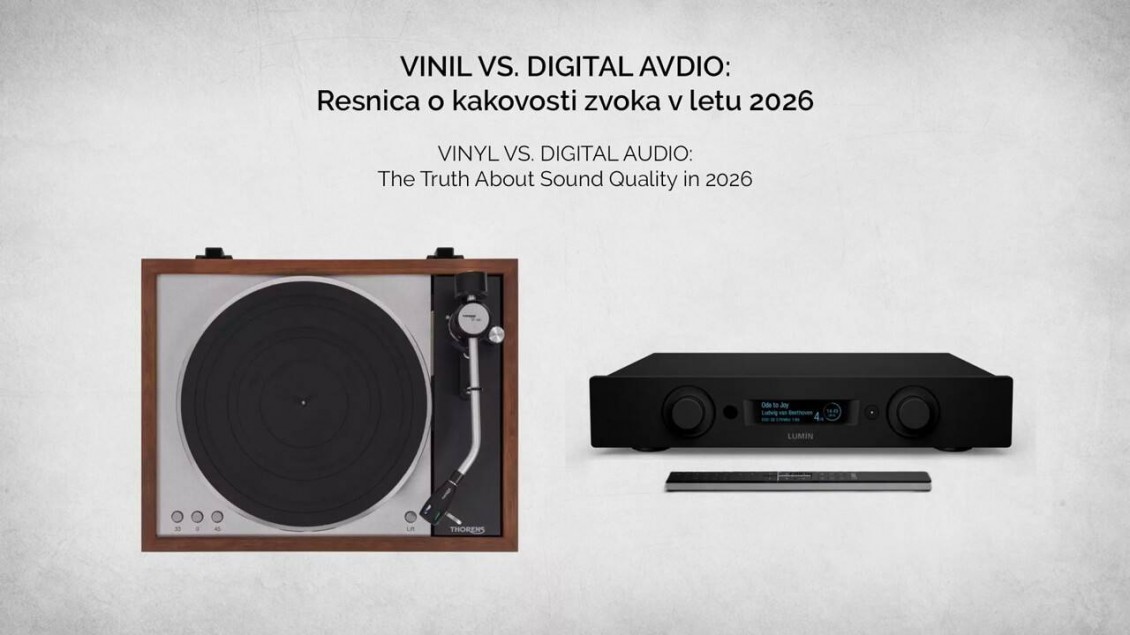
VINYL VS. DIGITAL AUDIO: The Truth About Sound Quality in 2026
A Question That Refuses to Die
Walk into any hi-fi shop, scroll any audiophile forum, or sit down for coffee with a friend who just bought their first turntable, and the same question surfaces sooner or later: which sounds better, vinyl or digital?The answer you'll hear most often is simple, confident, and wrong: "Vinyl sounds better because it's analog." This claim is repeated so frequently that it has hardened into something close to an article of faith. And yet, the moment you put it under the lens of engineering, physics, and the actual history of how music gets made, it falls apart.
The real story is far more interesting — and far more useful to anyone building a serious hi-fi system in 2026.
---
The Foundational Fact: Almost All the Music You Listen to Was Born Digital
Let's start with something many audiophiles would rather not confront directly: **the overwhelming majority of music recorded over the past four decades was tracked, mixed, and mastered digitally** — regardless of whether you ultimately listen to it on a streaming platform or pull it from a vinyl sleeve.This is not a recent development. Vinyl records aren't as analog as most people assume. Since 1979, record pressing has used digital tools to prepare records for your turntable. The culprit is the Ampex ADD-1 Digital Delay, introduced in May 1979 at the Audio Engineering Society convention — a device built specifically for vinyl cutting that soon became standard equipment in mastering studios across the globe. Almost every vinyl record you own has been digitized — not the music itself necessarily, but the actual mastering process used to cut it. And it's been that way since before you were born.
Today, the picture is even more stark. Only a handful of studios worldwide maintain a fully analog mastering chain. Everyone else works digitally.
This means that when you buy a new vinyl pressing of an album recorded in 2024 or 2025, you are almost certainly hearing **a digital recording converted into analog form** — not the reverse, as so many people assume.
Why This Matters for the "Which Sounds Better" Question
If the source material is digital, then the framing of "analog versus digital" stops making sense at the level of origin. What's actually being compared is **the same digital recording played back in two different ways**: once directly (digital playback) and once through a long chain of analog conversions that terminates on a vinyl disc, which your turntable then converts back into an electrical signal once again.The question more and more listeners are starting to ask is exactly the right one: if the music was created on digital gear and the release source is digital, does pressing it to vinyl actually improve anything about the sound? Likely not.
---
Does This Mean Vinyl Is "Worse"? No — It Means It's Different
This is the central point of the entire article, and it deserves to be stated with precision: **vinyl is not better than digital sound, because in the overwhelming majority of cases it simply cannot be** — since it originates from the same digital source. But that does not mean vinyl sounds bad, or that it has no place in a serious hi-fi system.Vinyl sounds **different**, and that difference is the product of a very specific, intricate chain of physical and electrical factors the signal must pass through before it reaches your ears. Digital playback does not carry this same chain — or carries a much shorter, far less variable one.
Let's look at what actually shapes the sound of a vinyl record in your home.
The Long Path the Signal Travels in Analog Playback
As the stylus tracks the groove of the record, the signal passes through the following chain — and **every link in this chain has the potential to change the sound**:1. The cartridge** — The transducer that converts the stylus's mechanical motion into an electrical signal. Different designs (MM, MC, MI) have different frequency responses, different tracking precision, and different sensitivity to vibration.
2. The wiring inside the tonearm** — The signals traveling between the turntable and the phono preamp are the most delicate in the entire analog audio chain. It is therefore essential to use a dedicated, low-capacitance tonearm cable in order to deliver every last nuance of musical detail contained in the grooves. High capacitance can cause treble frequencies to roll off prematurely, making music sound dull and lifeless — and this effect is especially pronounced with cartridges that are sensitive to capacitive loading.
3. The interconnect cable to the phono preamp** — Many in the industry consider this possibly the most important cable in the entire chain, even though it's frequently underrated by reviewers. Length, capacitance, and shield quality all directly determine how much noise and detail loss creeps into the signal before it's even amplified.
4. Grounding and shielding** — Shielding prevents external interference — like radio frequencies or electromagnetic interference — from corrupting the audio signal as it travels through the cables. Without proper shielding, hums, buzzes, or even faint radio signals can bleed directly into the music.
5. The phono preamplifier** — This stage doesn't just amplify an extremely weak signal coming off the cartridge; it must also accurately apply the RIAA equalization curve, a process that reverses the equivalent curve applied during the cutting of the master lacquer. Any inaccuracy here directly skews the tonal balance of the entire system.
6. Mechanical vibration** — The turntable is the only component in a hi-fi system that literally "listens" to vibration in its environment. Footsteps across the room, traffic outside, even the system's own loudspeakers — all of it can re-enter the signal chain through the stylus itself.
What This Means in Practice
Each of these six links is a **potential point of change** — and not necessarily an improvement. A meticulously assembled vinyl front end, with careful grounding, low-capacitance cabling, and a high-quality phono stage, can sound extraordinary. But the exact same record, played on a poorly grounded system with budget cabling, can sound noticeably worse than the same music delivered through a digital source.Digital playback does not carry this same fragility to the same degree. Once a file leaves the server and reaches your DAC, there's no mechanical stylus chasing microscopic irregularities in a groove, no tonearm cable capacitance bleeding away high frequencies, and no RIAA curve that needs to be precisely reversed.
---
So What Actually Drives Sound Quality in the Digital Era?
Hi-Res Streaming Has Reached a Level That Exceeds Most Systems — and Most Ears
Platforms like **Tidal** (via TIDAL Connect and its FLAC/Hi-Res catalog) and **Qobuz** (known for its deep commitment to Hi-Res content) now give listeners access to music at a resolution that would have been nearly impossible to obtain outside a professional studio just a decade ago.But here's a fact many audiophiles don't know, or don't want to accept: **standard CD-quality audio (16-bit/44.1kHz) was already, on its own, sufficient to fully cover the dynamic range of human hearing.**
CDs use 16-bit/44.1kHz and sound great because human hearing has roughly 120dB of dynamic range under ideal conditions, and real-world listening environments are much noisier than that. The difference between 16-bit and 24-bit is inaudible in a blind test through any consumer headphones or speakers.
With shaped dither, the perceived dynamic range of 16-bit audio reaches about 120 dB — and as Chris Montgomery of Xiph.org, co-author of the Opus codec, puts it bluntly: 16 bits is enough to store everything we can hear.
So Why Does Hi-Res Even Exist?
The reason for 24-bit isn't a better-sounding result for the listener — it's headroom for the studio. During recording and mixing, where noise from multiple sources accumulates, working in 24-bit preserves enough working margin before the final product is created. Even the best 24-bit converters achieve about 120–124 dB of actual dynamic range in practice, so these formats are mostly about giving engineers more room to work — not about delivering audibly better quality to the end listener.This is the key insight: **Hi-Res isn't a marketing gimmick, it's a studio tool.** By the time a track reaches you as a listener through Tidal or Qobuz, the music has already reached a level of quality where even the most advanced DACs — and the human ear itself — cannot detect meaningful additional detail beyond what CD-quality already captured, except under extremely specific, controlled laboratory conditions.
Our Systems — and Our Ears — Have Reached the Ceiling
This may be the single most important point in this entire article: **modern digital recordings are captured with such precision and such high dynamic range that our playback systems — including exceptional hi-fi equipment — and our own ears can no longer fully perceive everything contained in them.**The threshold of human hearing sits at 0dB SPL, while the threshold of pain is around 120dB SPL. As such, the 144dB of dynamic range that 24-bit audio offers is already high enough to capture sounds quieter than we can hear and louder than we can tolerate.
In other words: when it comes to listening to music at home, we crossed the point long ago where additional technical resolution would deliver an audible improvement. The limiting factor is no longer the file format — it's the acoustics of your room, the quality of your speakers, the mechanical stability of your equipment, and — something frequently forgotten — **the physiological limits of your own hearing.**
---
So What Are We Actually Comparing When We Compare Vinyl and Digital?
When we say "vinyl vs. digital," we are not actually comparing two different levels of fidelity to the same source. We are comparing:A short, direct digital path — file, DAC, amplifier, speakers — through a format that has already exceeded the perceptual limits of human hearing.
versus
A long, physical path through six or more analog links — each carrying its own potential to add colour, loss, or distortion — that ultimately converts the very same original digital signal back into sound.
Neither path is "wrong." But it is intellectually dishonest to claim that vinyl is objectively more faithful to the original recording when that original recording is itself digital. What vinyl offers is not greater fidelity — it is a **different interpretation**, shaped by concrete physical principles and the specific equipment you choose to build around them.
Vinyl can sound genuinely different from streaming and CD. It's just not for the reason most people assume.
---
So What Are You Actually Hearing When Vinyl Sounds "Warm"?
One of the most persistent myths is that vinyl's "warm" sound comes from analog purity. The real story is far more interesting.The music industry spent roughly 30 years fighting the "loudness war," starting in the early 2000s. Mastering engineers squeezed the dynamics out of songs using compression and brickwall limiting. Vinyl physically can't handle that. If you push a record too hard, the cutting stylus skips — the groove simply won't contain it. So engineers who care about the vinyl format often create dedicated versions with more headroom, lighter compression, and preserved dynamics. The music sounds less squashed.
This means a vinyl release often sounds better than its streaming counterpart **not because of analog transmission**, but because it was mastered with less compression, since the medium physically demanded it. That's a completely legitimate difference in quality — but its cause lies in a mastering decision, not in the format itself.
But here's the catch: many modern vinyl releases today are cut from the exact same digital master as the streaming version. No special mastering. No preserved dynamics. Just the same compressed source pressed to plastic, with the added mechanical noise that comes from needle-on-groove playback. In those cases, vinyl simply doesn't sound better.
---
What This Means for You as a Listener in 2026
If You Love Vinyl
Keep loving it. Vinyl offers a ritual, a tactile presence, large-format artwork, and a listening experience many people genuinely treasure for its own sake. But choose your equipment with a clear understanding that **every link in the chain — cartridge, tonearm wiring, interconnect cables, grounding, phono preamp — directly shapes what you'll hear.** Investing in a properly assembled chain isn't a luxury; it's a necessity if you want vinyl to actually sound the way it should.If You Value Hi-Res Streaming
Tidal and Qobuz today give you access to a music library at a quality level that exceeds the practical limits of human perception. You don't need more expensive equipment to "capture" extra detail that CD-quality wouldn't have already delivered — you need good room acoustics, quality speakers, and a stable DAC.If You're Building a System That Includes Both
This is the smartest path. Vinyl for the experience and for specific pressings where dynamics were genuinely preserved because of the medium itself. Hi-Res streaming for convenience, consistency, and access to an enormous library without compromising on quality.---
The Truth Isn't in the Format — It's in the Chain
Vinyl is not better than digital sound. It can't be — since in the overwhelming majority of cases, it originates from the very same digital source. But vinyl isn't worse, either. It is a **different, more elaborate path** to the same destination, threaded through six or more physical and electrical links, each contributing its own share to what you ultimately hear.Digital, meanwhile, has already reached a point where additional resolution no longer delivers an audible difference for the average listener — the limit isn't in the format anymore. It's in our systems, and in our own ears.
The best choice isn't a question of "which is objectively better." It's a question of which sound, which experience, and which path to the music means the most to you.
---
INTEK Hi-Fi: Helping You Build a System That Truly Sounds Right
At INTEK Hi-Fi, we understand both worlds — analog and digital — and we know that true sound quality isn't found in a format, but in a carefully assembled chain. Whether it's choosing the right cartridge and phono preamp for your turntable, or building a digital system that makes full use of Hi-Res streaming through TIDAL Connect or QOBUZ Connect, we're here to help you find the right path.Call us or visit us — let's talk about your system and your goals.
INTEK Hi-Fi | Ljubljana | Slovenia
High-End Audio, Consultation and Distribution