
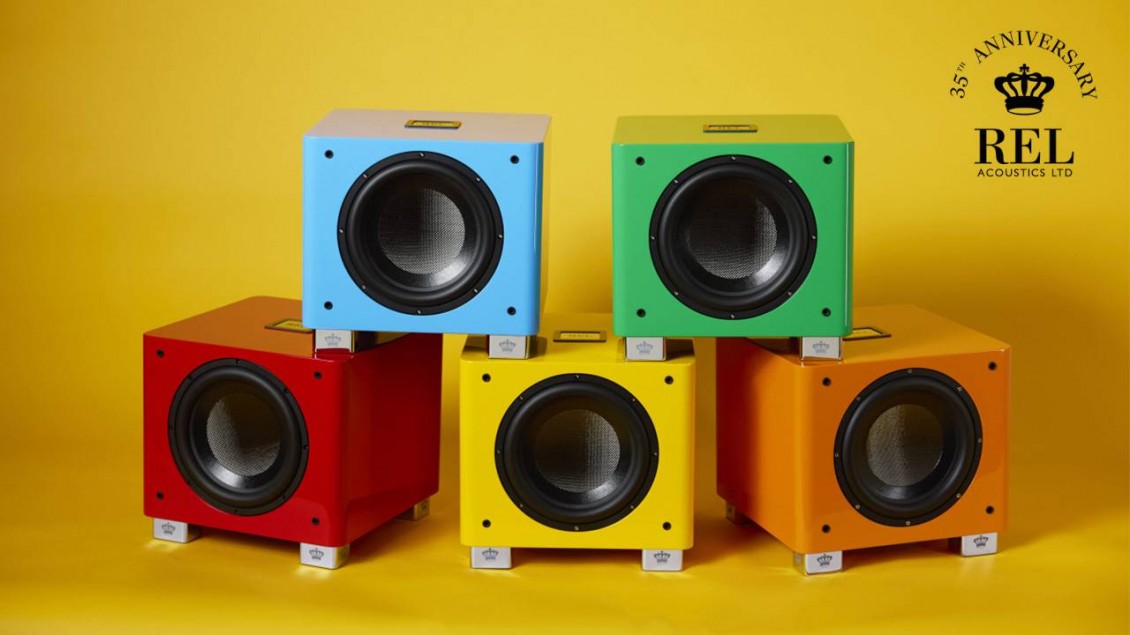
REL ACOUSTICS - A Subwoofer That Doesn’t Sound Like a Subwoofer
Why listeners who have properly heard a REL in their system rarely consider anything else. A look into the technology, philosophy, and the complete REL Acoustics lineup.
Almost every good hi-fi system eventually hits the same obstacle. The speakers flawlessly render mids and highs, possessing beautiful dynamics and tone, but simply run out of breath in the lowest octaves. The solution seems obvious: add a subwoofer. And this is exactly where most listeners are disappointed.
A typical subwoofer does deepen the bass, but it often ruins everything that was previously beautiful about the system. Low frequencies become slower than the rest of the signal, sounding thick and undefined, and above all, they can be heard as a separate sound source. The room suddenly sounds like two systems playing simultaneously: one for bass, the other for everything else. The transition between them is audible, and it is precisely this transition that quickly ruins a good listening experience.
Consequently, after a few weeks, many simply turn off the subwoofer or return it to the store, convinced that the bass in their system is simply unsolvable. It is a shame because the problem usually isn't the idea of a subwoofer, but how it is connected to the rest of the system.
From the very beginning, REL Acoustics has tackled this problem differently than most of the market. Instead of treating the subwoofer as an additional channel with its own signal source, they designed it as an extension of the existing speakers. The result is bass that doesn't sound like an add-on, but rather like a part of the same music.
One Speaker, Not Two Separate Systems
The brand was founded in Wales in 1990 by Richard Edmund Lord, after whom it is named (REL being his initials). Lord was bothered by the fact that the subwoofers of the time couldn't keep up with the speed and articulation of good speakers, so he built his own that could. Since 2005, the company has been led by John Hunter, a longtime expert in European speaker brands. Under his leadership, REL accelerated its development while maintaining its founding philosophy: bass must be fast, precise, and above all, undetectable as a separate source.
In practice, this philosophy manifests as a single decision that REL repeats across its entire lineup, from the most accessible to the most expensive models: the subwoofer does not connect to the AV receiver's effects output (.1/LFE), but directly to the amplifier's output terminals—meaning it receives the exact same signal that the main speakers are receiving at that very moment.
REL also adheres to the unofficial motto "Do One Thing. Do It Perfectly." Therefore, you won't find amplifiers, speakers, DACs, or cables in their lineup—only subwoofers developed exclusively for the sub-bass completion of existing systems. This focus is evident in details that a manufacturer stretched across ten different product categories often doesn't have the time to perfect.
High-Level Connection: The Heart of REL's Technology
Most subwoofers on the market receive their signal via an RCA input from an AV receiver or preamplifier. This is simple, but it has a consequence: the subwoofer gets a separate, pre-filtered copy of the signal that travels a different path than the signal going to the main speakers. Even a slight difference in the timing, phase, or tonal balance of this path becomes audible as a slight delay or as bass that "doesn't belong" to the rest of the sound.REL utilizes a High-Level connection via a Neutrik Speakon connector, which plugs directly into the amplifier's output terminals using the provided cable, parallel to the cables already running to the main speakers. The subwoofer thus receives the exact same signal, with the same temporal and tonal signature, that the main speakers are reproducing at that exact moment, regardless of whether it is a Class A, A/B, or D amplifier. It draws no power from the output terminals, and the amplifier does not register the signal on this path any differently than if a single additional (very high-impedance) pair of cables were connected.
Simplified High-Level connection scheme: Amplifier > L Speaker / R Speaker > REL Subwoofer High-Level (Speakon)
Conventional subwoofer: separate RCA / LFE input from the AV receiver, different signal path than the main speakers.
REL: listens directly at the amplifier's output terminals, not through a separate effects output.
Every REL also retains a classic low-level (RCA) and LFE input, meaning the same subwoofer works seamlessly in a home theater system, where the LFE channel from the AV receiver is naturally required for movie effects. Models from the Reference series go a step further and can simultaneously receive and separately filter both signals—High-Level for music and LFE for effects—so that when watching a movie, the effects and the musical score do not interfere with each other.
Why It Sounds Different
The consequence of the High-Level connection is not just theoretical. Because the REL receives the same signal as the main speakers, it automatically inherits their tonal character, dynamics, and timing. Instead of the listener hearing "speakers plus a subwoofer," they hear a single, coherent system extending down into octaves the main speakers couldn't otherwise reach.REL's approach to building amplifiers and filters within the subwoofer itself also helps. Across the entire range, from entry-level to reference models, REL uses fast, minimally invasive filters and amplifiers with massive power reserves, designed to track transients—rapid volume changes during a drum strike, a double bass pluck, or a movie explosion—without smoothing or slowing them down. This speed is precisely why experienced listeners often describe REL bass as "musical" rather than merely "deep."
"A good subwoofer does not add a new sound to the system. It removes the boundary that was there before."
The resulting versatility is equally important. Because the REL tunes itself to the signal generated by the main speakers rather than a fixed frequency window, it naturally adapts to the character of your speaker setup, whether it's small bookshelf monitors needing help below 80 Hz or large floor-standers missing only the final octave.
Therefore, there are intentionally few knobs on the back of each model—not out of cost-saving, but out of philosophy. Separate volume and crossover frequency controls, plus a phase switch (0°/180°), are all the listener actually needs because the rest of the work—the tonal matching—is already handled by the High-Level signal itself. Fewer variables mean fewer chances to tune things in the wrong direction.
Who Is a REL Subwoofer Actually For?
Because REL stems from the world of two-channel music, many incorrectly categorize it exclusively as a hi-fi accessory for music listening, while assuming other, "louder" subwoofers are better suited for home theater. In practice, the difference is smaller than it seems. Models from the Reference series and the larger representatives of Serie S are designed to simultaneously accept a High-Level music signal and a separate LFE channel for film effects. Thus, in the same system, they effortlessly take on both roles: musical bass for an album and a massive impact for an action scene.The smaller models from Serie T/x are a logical choice primarily where the main speakers (bookshelf or smaller floor-standing) only need help in the final octave or two, meaning for truly two-channel, music-oriented setups. Serie HT, which operates exclusively via the LFE input, is intended for systems where the focus is clearly on home theater and where a High-Level connection is unavailable for any reason—for example, with AV receivers lacking free output terminals for an extra pair of cables.
Room size is another variable. For smaller rooms and desktop setups, the entry-level model from Serie T/x is sufficient. For medium to large living spaces, it makes sense to consider at least the upper end of that same series or Serie S. For truly large spaces, home theater rooms, or demanding audiophiles, the Reference series belongs, preferably in a pair or even a vertically stacked configuration.
A Setup That Actually Works
One of the biggest reasons subwoofer owners often get a bad impression of them isn't the speaker itself, but the setup. The wrong crossover frequency, incorrect phase, or excessive volume cause that familiar "boom" effect where the bass overpowers everything else.Because REL receives an already shaped, tonally matched signal from the amplifier, the starting point for setup is completely different. Using separate knobs on the back of the subwoofer, the user adjusts only the volume and crossover frequency, without needing intermediary processors or apps. Since the signal naturally matches the tonal character of the system, the path to a correct, imperceptible setup is significantly shorter than with subwoofers tuned independently of the main speakers.
In practice, the setup goes something like this: the volume is initially set quite low, then gradually increased until the subwoofer first becomes noticeable as a separate source. After that, it is dialed back slightly until it "disappears" back into the whole. The crossover frequency is adjusted based on where the main speakers actually start losing power, and the phase is checked by simply toggling between 0° and 180° while listening, keeping the setting where the bass sounds full rather than hollow or thinned out. The entire process usually takes less than half an hour, even for someone who has never set up a subwoofer before.
For those who don't favor a cable running from the amplifier to the subwoofer, REL also offers a wireless option via the Arrow accessory or the newer Airship Direct system, which transmits the signal with no perceptible loss of quality or listening delay.
Why At Least Two Subwoofers Make a Substantial Difference
A single, yet frequently emphasized REL recommendation is the use of two (or more) subwoofers instead of one. This isn't just marketing advice to sell an extra piece of equipment; it's a consequence of the physics of low frequencies in a real room.Low frequencies have wavelengths comparable to room dimensions, so "room modes" (places where bass waves add up or cancel each other out) form in every space. A single subwoofer in one corner inevitably creates an uneven bass field: on one seat, the bass is strong and full, while two meters away, it almost disappears. An additional subwoofer on the other side of the room largely smooths out these dips and peaks because each subwoofer excites the room modes from its own position, making the combination of the two significantly more even across the entire listening area, not just in one specific spot.
In stereo systems, a second subwoofer has an added advantage. If each channel, left and right, gets its own High-Level connection—meaning the left subwoofer gets the signal from the left channel and the right from the right—some spatial information is preserved, which is actually more present in the bass than one might expect. The result is not "stereo bass" in the sense of localizing an individual instrument, but a wider, more open, and less rigid bass image that matches the overall width of the stereo soundstage.
The practical outcome is simple: a pair of smaller, less expensive REL subwoofers on opposite sides of the room often sounds better and more even than a single, larger, and more expensive model in one spot. This is why practically every model in REL's lineup exists with the idea that the listener will eventually purchase a pair.
Craftsmanship You Can See and Feel
REL's philosophy doesn't stop at electronics. In the higher series, cabinets are built from Australian MDF, chosen by the company primarily because it yields flatter and smoother surfaces than alternatives, which is especially important for high-gloss finishes. Reference series models receive up to 13 coats of lacquer, applied and hand-polished in multiple stages, achieving a depth and reflection more reminiscent of luxury car finishes than standard hi-fi equipment. Real wood veneer grilles are also available, adding warmth to spaces where a black or white high gloss might look too technical.This attention to detail isn't an indulgent gesture. For a subwoofer that will sit prominently in a living room, appearance is just as important a part of the decision as the amplifier's specifications. REL is one of the few manufacturers dedicating this much attention across its entire lineup, not just to the most expensive models.
The REL Acoustics Lineup by Series
REL categorizes its models by purpose and ambition, not just by price. Every series follows the same core philosophy (High-Level connection, fast Class A/B or D amplifier, minimal filtering), but with different emphases on room size, power, and finish refinement.Serie T/x: The Gateway to the REL World
Serie T/x is the most widespread REL family and the one the brand is most recognized for among hi-fi enthusiasts. The range spans from a compact model for smaller rooms and desktop setups to the flagship T/9x, which boasts a 10-inch active driver, a 10-inch passive radiator, and a 300-watt Class A/B amplifier—the same amplifier family REL has used since 2006, known for its exceptional reliability. The series is designed for owners of bookshelf or smaller floor-standing speakers missing the final octave, rather than the entire bass register.Purpose: Small to medium rooms
Amplifier: Class A/B
Connection: High-Level, RCA, LFE
Wireless: Optional (Arrow)
Serie S: For Medium to Large Rooms, Without Compromise
Serie S is intended for listeners who have already upgraded their main speakers to a higher level and need a subwoofer that acts as an equal partner, not just a supplement. Models in this series use faster, lighter drivers and newly designed passive radiators, alongside amplifiers with up to 1,000 watts of power, enabling truly limitless dynamics even at high volumes. Mechanical couplers on the bottom of the cabinet also allow multiple units to be stacked, which is especially useful where floor space is limited but serious sub-bass power is required.Purpose: Medium to large rooms
Power: Up to 1,000 W
Special feature: Stackable setup (Line array)
Wireless: Optional
Reference Series (No.31 and No.32): The Top of the Range
The Reference series represents the absolute pinnacle of REL's offerings. The No.32 uses a 15-inch pure carbon fiber driver and a latest-generation 1,000-watt Class D amplifier. The No.31 delivers almost the same experience in a more compact yet equally refined cabinet with a 12-inch driver and up to 1,000 watts of power, designed for spaces where the No.32 physically won't fit. Both models can simultaneously and separately filter the High-Level music signal and the LFE effects channel, making them equally compelling in a pure music system or a reference home theater. A special feature of the Reference series is the ability to vertically stack up to three (or even five in exceptionally tall rooms) units in a line array, opening up an entirely new dimension of spatial sound that simply cannot be achieved with a single subwoofer.No.32: 15" carbon driver, 1,000 W
No.31: 12" carbon driver, up to 1,000 W
Special feature: Vertical stacking (Line array)
Planar: Bass That Disappears into the Wall
Planar is the newest and conceptually most distinct addition to the lineup. Instead of a classic cabinet, it is designed to mount directly onto a wall. At only about 14.5 centimeters deep, it utilizes the proximity of the wall itself as part of its bass acoustic load. The PL-2 model uses an 8-inch active driver and a 10-inch passive radiator, while the smaller PL-1 uses two 6.5-inch active drivers alongside the same passive radiator. Wireless connectivity is built-in by default, making the Planar series a logical choice for modern, open spaces where a classic subwoofer cabinet simply isn't an option, while the sound remains completely in line with REL's broader philosophy.Depth: approx. 14.5 cm
Placement: Wall-mounted, mobile (cart), or floor-standing
Wireless: Built-in
Serie HT: For Those Building a System Around Movies
Where the dominant use is home theater rather than two-channel music, REL offers Serie HT, a more affordable line designed exclusively for a low-level (LFE) connection to an AV receiver. Even though the High-Level connection isn't the focus here, the series maintains REL's signature approach to driver speed and control, meaning significantly more articulated bass during film effects compared to generic solutions in a similar price bracket.Frequently Asked Questions About REL Subwoofers
Can I connect a REL if I only have an AV receiver without a separate amplifier?Yes. The High-Level connection does not necessarily require a standalone hi-fi amplifier; it works equally well via the free output terminals for the main channels on an AV receiver. If these terminals are not free because the receiver is using them for height channels or an additional zone, the classic LFE input remains available and is supported by every REL model.
Can the High-Level connection damage my amplifier?
No, as long as the connection is made correctly. The REL input has an extremely high impedance, so it draws virtually no current from the terminals. The amplifier registers it, at most, as an extra, very lightweight speaker cable. The only thing to watch out for is correct polarity (red, yellow, and black wires to the right terminals), which is hard to mix up given the clearly marked included cable.Do I really need two subwoofers, or is one enough?
A single REL subwoofer is certainly a sensible start and will work excellently in many smaller rooms. However, two subwoofers fill the room with bass much more evenly by reducing the impact of room modes mentioned above, which is why REL recommends a pair wherever the budget allows.Where in the room should I place the REL subwoofer?
It is best to start near one of the main speakers or in a nearby corner, and from there gradually look for the spot where the bass sounds fullest and most even across the entire listening area, not just on one seat. With a pair of subwoofers, it is often best for each to stand on its own side of the room, close to its corresponding channel, not necessarily symmetrically next to each other.Does a REL subwoofer work with speakers from other brands?
Yes, the High-Level connection is universal and not tied to a specific brand of speakers or amplifier. The REL subwoofer simply adopts the tonal character of the signal your existing system is sending at that moment, regardless of who made the speakers or amplifier.Hear the Difference in Our Listening Room
A description on paper can never replace actual listening. The difference brought by a properly connected and tuned REL is something best understood when you briefly disconnect the subwoofer from the amplifier and then turn it back on—only to realize you weren't even sure if it was playing in the first place. At INTEK Hi-Fi, we have multiple REL Acoustics models available, from Serie T/x to the Reference series, which we will gladly connect to your system or our demo system, in both single and stereo pair configurations, so you can hear the difference the High-Level connection makes with your own ears.Schedule a demonstration.
REL ACOUSTICS